- Braun & Brains
- Posts
- When You Can Gamble on Anything, Everything Feels Rigged
When You Can Gamble on Anything, Everything Feels Rigged
PLUS: Warehouse robotic dogs and NVIDIA’s Ralph Lauren sweater dupe.

Rachel Braun
March 24, 2026
Hello world,
Happy March Madness to all who celebrate. This year, Americans will legally wager an estimated $3.3B on the tournament, according to the American Gaming Association. In 2018, America legalized sports betting and over the past eight years, this form of gambling has become completely normalized. I find it absolutely bananas… and I think prediction markets are going to move even faster.
Last week, I learned that since the legalization of sports betting:
Searches for “Am I addicted to gambling?” spiked 25%, helpline calls from young men surged, and Americans wagered more than $160B on sports last year, up from $4.9B in 2017.
Up to 90% of sportsbook revenue comes from fewer than 10% of users.
The apps are built like TikTok and Candy Crush, engineered for a hypnotic loop, while executives talk about “responsible gaming” with a straight face.
All of those data points came from “Sucker“ in the Atlantic, where author McKay Coppins, a Mormon suburban dad, started sports betting for a reporting experiment. He documents his time getting into sports betting, how addictive it became, how it changed the way he watched sports and structured his days, and how the apps are designed to keep you hooked.
His wife caught him betting in church.
His 7 year old knew the difference between a point spread and a moneyline (and I do not lol)
He was sneaking bets during a Christmas choir recital, sitting outside the church while his daughter performed.
His 10 year old’s first question whenever a game came on was “who are we betting on?”
He overdrew his checking account on Super Bowl night.
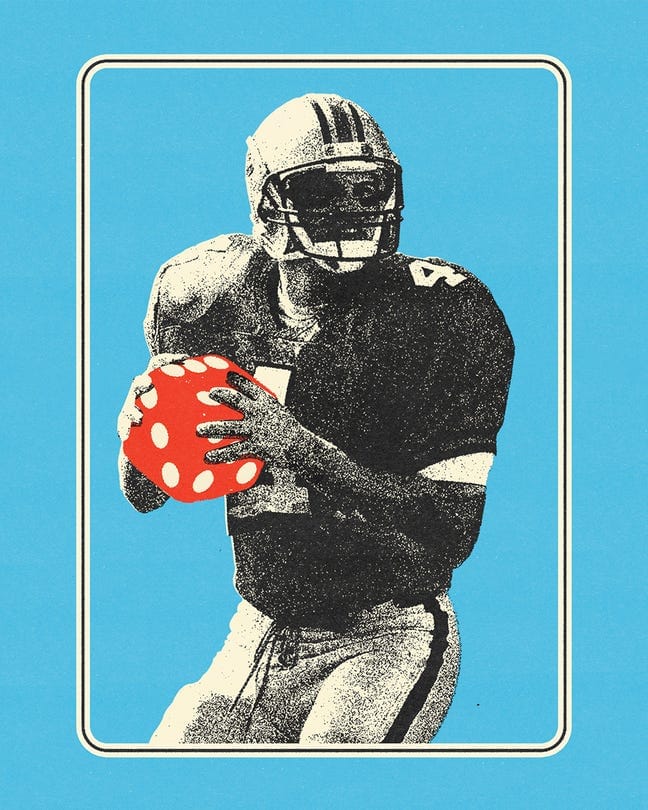
Illustration by Tyler Comrie | Sucker
The documentation of his downhill slide was horrifyingly entertaining, but it also got at something less discussed: sports betting as a poison for fandom. It fuels harassment of athletes and paranoia about rigged games. Now, 65% of Americans believe professional athletes sometimes change their performance to influence gambling outcomes.
Gambling had a rebrand when sports betting came along, turning the focus away from casinos and slot machines and putting all eyes on fandoms and communities. Prediction markets are the next rebrand, letting you bet on real-world outcomes like war, elections, and even the weather, reframing it all as financial forecasting.
Each iteration makes it harder to call it what it is. When everything becomes something to bet on, it also becomes something to doubt. People using prediction markets may start to see everything as potentially rigged, similar to how sports bettors operate. The difference is that the stakes are much higher, as these markets are increasingly being used in finance as forecasting tools for politics, global conflicts, and crypto prices.
Breaking down the big difference between sports betting and prediction markets:
Sports betting is regulated at the state level, with each state that allows it setting up their own rules. Sportsbooks like DraftKings or FanDuel have to comply with all of this.
Prediction markets are regulated federally by the CFTC, which has been more chill under the Trump administration, allowing platforms like Kalshi to operate across all 50 states with fewer restrictions, less oversight, and no requirement to include responsible gambling messaging.
Note: Donald Trump Jr. is an investor in and an unpaid adviser to Polymarket, and a paid adviser to Kalshi. His father’s company, Trump Media, which operates Truth Social, announced its own prediction market platform called Truth Predict last year.
This means prediction markets can let people bet in all 50 states without having to comply with the same rules as sports books. This pisses the states and the sports books off, rightfully so.
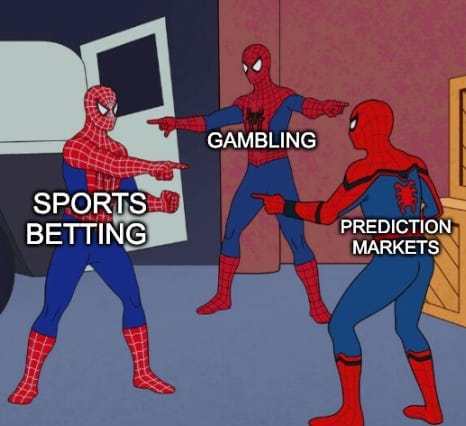
Yesterday, March 23rd, a bipartisan Senate bill was introduced to ban prediction market platforms from allowing wagers on sporting events. Nevada temporarily banned Kalshi’s operations, Arizona filed criminal charges against the company for running an illegal gambling operation without a license, and Kalshi’s response was that banning them would just push the behavior offshore… which it might.
On the same day, Kalshi said it will block athletes, coaches, officials, and political candidates from trading on markets tied to their own games or campaigns. These were already banned technically, but the update they made will be more proactive prevention.
Polymarket also announced they’re introducing enhanced market integrity rules, banning trading based on stolen confidential or illegal tips. It also will prohibit trading by those who can influence the outcomes of the events directly.
Despite the Senate’s effort to legally separate sports betting and prediction markets, culturally the two seem to be fusing together. A Reddit commenter put it best: ‘Soon we’ll have PSAs for prediction addiction treatment services and everything will come full circle.’
Over the weekend, Polymarket opened up what they’re calling “The Situation Room”, which is basically a sports bar but on the screens they’re sharing “live X feeds, flight radar, Bloomberg terminals, and Polymarket screens” allowing attendees to use their prediction market in real time. On opening night, none of the TVs worked. CNBC called it a “botched opening” and I’m calling it a warning sign.
Axios reported that only 4% of Americans have used a prediction market, yet 61% already view them as gambling, not investing. Regulation hasn’t caught up, but Wall Street isn’t waiting for anyone to make the rules before playing the game. The parent company of The New York Stock Exchange, Intercontinental Exchange, invested $2B in Polymarket. Institutional investors, hedge funds and banks are trading event contracts directly, acting as market makers providing liquidity, and using prediction markets to hedge risk or inform broader investment strategies. ETFs tied to prediction outcomes are already being proposed to the SEC.
This might be easier to understand: An ETF is a basket of assets, usually stocks, that you buy a share of. When you own an ETF you own tiny pieces of real companies that have earnings, employees, and products. Your money is tied to something that produces value. A prediction market ETF doesn’t hold any of that. It just takes your money and puts it on a yes or no outcome. There’s nothing underneath it.
Kalshi’s CEO says “if we are gambling, then you’re basically calling the entire financial market gambling.” By that logic, poker is investing. Sports betting is investing. Any wager where you assess probability and put money down is investing.
I’ve written the word investing so many times, it has started to look wrong at this point, but to break it down clearly:
When you invest, you buy ownership in something productive. A stock represents a claim on a real company’s earnings, assets, and future cash flows. You’re allocating capital toward something that creates value.
Prediction markets don’t do that. You’re not buying into anything. You’re guessing at an outcome and redistributing money between people doing the same, while the platform takes a cut. That’s literally gambling.
Prediction markets want to be treated as news, as signal, as forecast, but at best they’re educated guesses and at worst they’re gambling with a better aesthetic. They aren’t outcomes.
Good luck.
Tech News
Always Watching
People hate being watched. There are more than 80K AI-powered Flock Safety cameras are deployed across 49 states, scanning 20B vehicles per month for 5,000+ law enforcement agencies. In the past six months, 38 cities have rejected or shut off the cameras over backlash related to data sharing with federal immigration authorities. (TechCrunch)
Robot dogs!!! Boston Dynamics’ Spot robots, priced $175K-$300K each, are now autonomously patrolling data centers across the US with 24/7 video surveillance and industrial inspections. There are 5,000+ data centers in the country with 800-1,000 more under construction; payoff vs. a human guard at $150K/year is under two years. (Fortune)

Meta announced it’s killing end-to-end encryption in Instagram DMs effective May 8, saying “very few people” opted in. Once encryption sunsets, Meta regains the ability to scan DM content, reopening the door to automated moderation and easier law enforcement compliance. This is a full reversal of Zuckerberg’s 2019 “privacy-focused vision for social networking.” (Fortune)
NVIDIA
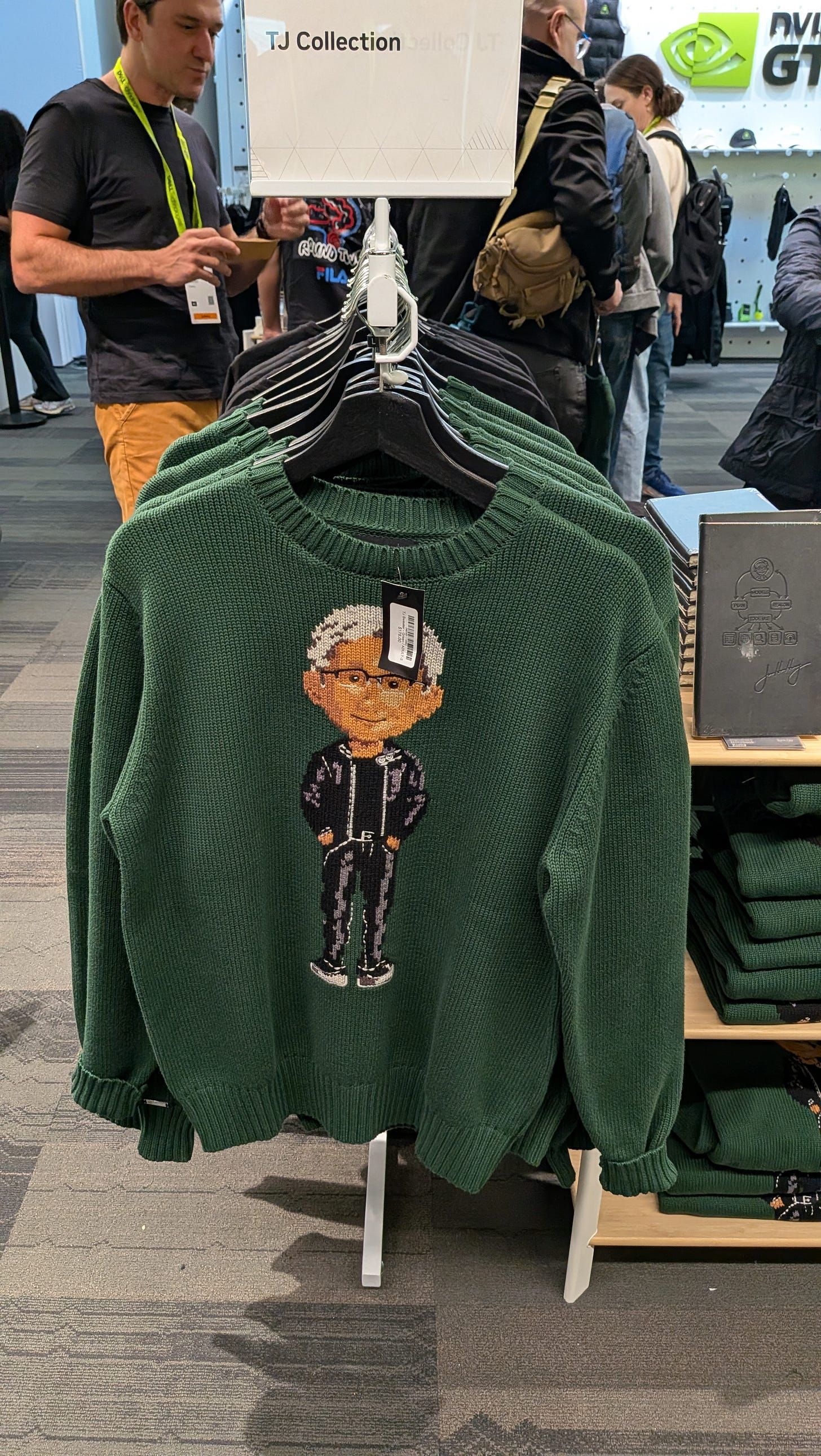
NVIDIA is selling a $178 knitted sweater at GTC featuring “Toy Jensen,” an AI avatar of the CEO, in a design that looks a lot like Ralph Lauren’s Polo Bear.(TechRadar)
Jensen Huang announced that NVIDIA is heading to space. The Vera Rubin Space-1 Module at GTC, a chip system designed to run AI data centers in orbit. He expects purchase orders to hit $1T through 2027. (CNBC)
Anthropic
Vanity Fair’s Joe Hagan published a piece in which he used Anthropic’s Claude to fabricate portions of a profile on Anthropic CEO Dario Amodei, framing it as “a first-person odyssey through the mirrored funhouse of the AI world.” The article pissed people off, especially writers who flagged the AI-generated passages as deceptive and only disclosed at the very bottom. (Vanity Fair)
Senator Bernie Sanders posted a three-minute video of himself questioning Claude about AI privacy and data collection. Claude told him companies pull data from “practically everywhere” and that privacy is “a democracy issue.” The bot mostly agreed with everything Sanders said. (Instagram)
Europe
The European Commission came out with “EU Inc,” a new optional company structure that lets founders register across the entire EU in under 48 hours for less than €100, with no minimum share capital. The Commission projects 300K companies will use it in its first decade, employing 1.6M people. This is a big move to stop European startups from reincorporating in Delaware.(Bloomberg)
European chip buyers are tapping backup stores and paying premium prices as the Iran war disrupts air freight routes from Asia. Global air freight capacity is down ~9% since fighting began Feb. 28, with cargo planes that used to refuel in the Middle East now flying direct with reduced payloads. (CNBC)
Reply