- Braun & Brains
- Posts
- Wall Street Panicked over a Sci-Fi Substack on AI. Then One of the Largest Layoffs Happened.
Wall Street Panicked over a Sci-Fi Substack on AI. Then One of the Largest Layoffs Happened.
A viral Citrini substack about AI’s work impact, the response from Citadel and a disclosure debate, and Block's 40% layoffs.

Rachel Braun
February 27, 2026
Hello world,
This week, Braun & Brains welcomed quite a few new subscribers. As a special thank you, I decided to drop an extra newsletter, sans my usual tech news roundup at the end. I know many of you like that section, but a string of events online has taken over my feed that I think we need to talk about.
A fictional Substack post about AI in the workplace went viral, drew responses from Wall Street, sparked a disclosure debate on X, and arrived just as Block announced, citing the rise of “intelligence tools,” one of the largest layoffs in S&P 500 history: 40% of its entire workforce.
Let’s get into it.
On February 22, a research Substack called Citrini published The 2028 Global Intelligence Crisis, writing about fictional future where AI systems take over large amounts of white-collar work. Companies need fewer employees, productivity rises, income growth slows, and consumer spending weakens, eventually putting pressure on the broader economy. You get the idea.

The post spread like mf wildfire across finance, family group chats, and tech circles alike. There were two big responses:
On February 24, Citadel Securities released a response clapping back on the idea that AI-driven disruption is already reshaping labor markets. Their note pointed to stable hiring data and argued that deploying AI at scale requires enormous compute, infrastructure, and organizational change, slowing real-world adoption. This all unfolded alongside a broader selloff in software stocks, as investors increasingly questioned how AI might reshape the economics of traditional enterprise software.
If this is not clear to you: A Substack post got big enough that institutional players felt the need to respond. Shaking in their boots, if you will. This is like when Instagram influencers began selling more effectively than celebrity endorsements. This is huge. Probably not the first time it’s happened, but still big enough that you should be looking at it with your mouth slightly agape.

Then the story shifted from AI economics to disclosure ethics. Readers noticed that the original email version of the Citrini report credited collaboration with LOTUS, which is connected to hedge fund manager Alap Shah. A few days after the original report was published, Shah went on Bloomberg and said his fund held short positions in some companies discussed in the report as vulnerable to AI disruption. People also noticed that wording on the public website version later described Shah’s involvement differently from how it appeared in the original email!!!
I suggest checking out “Vibe laundering, pt. 1: On Citrini Research, disclosure gaps & the architecture of influence” and “Vibe Laundering, Pt. 2: Citrini, the Co-Author and the Edit (remix not featuring the SEC” on all of this.
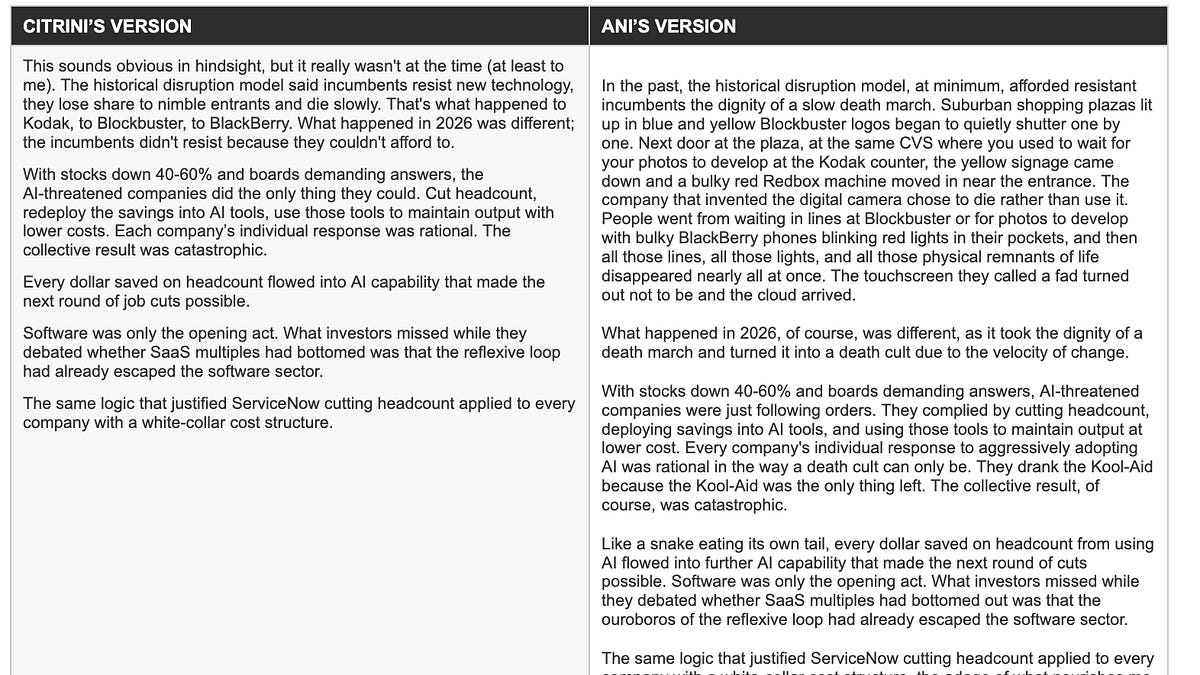

Then reality added an interesting and relevant data point. Yesterday, on February 26, there Block announced the largest workforce reduction as a share of total employees in S&P 500 history, according to TBPN cohost Jordi Hays. The company is cutting roughly 4,000 employees, shrinking from more than 10,000 workers to under 6,000. In his internal note, Jack Dorsey said the company wasn’t struggling financially and said “intelligence tools” are allowing for smaller, flatter teams to operate differently. In other words: fewer people needed to do the same work… Which is… basically the core premise of the Citrini memo.
* gasps *
Before anyone freaks out, there have been other major companies that have gone through large layoffs in the recent past, and we probably can’t point fingers and blame AI as the only reason people are losing their livelihoods.
I personally don’t think I’ll be replaced by AI anytime soon, but my position might evolve with the times. I work hard, and when I see parts of my job that can be automated, I’m proactive about learning the tools and incorporating them into my workflow. The goal is to keep quality high while benefiting from the speed of “intelligence” tools.
I also think people genuinely like working with me, which, honestly, is about a third of job security in my field if I’m being honest. I work in podcasting, where editorial direction and judgment are still hard to replicate. Because of that, I don’t think my role is first on the chopping block.
Or maybe I’m just cocky.
Tell me what you think about AI in the workplace, Substack disclosures, and CEOs tweeting layoff announcements.
(I also feel compelled to say that I value artistic forms of expression created by people. I like things like painting, comedy, memoirs, and handmade sweaters. I hope we all continue to value them enough that they’re never optimized out of existence. If you’re making something, keep it up. Scroll past the AI-doomer content once in a while.)
Reply