- Braun & Brains
- Posts
- The Dead Can't Say No: Ghost Influencers, Death Policies, and the Postmortem Internet
The Dead Can't Say No: Ghost Influencers, Death Policies, and the Postmortem Internet
PLUS: What Sam Altman Has to Say About AI’s Energy Usage, Thinking Fast and Shitposting, and Santa Fe’s Gunfire Detection System

Rachel Braun
February 25, 2026
The more I think about it, the more I find it odd to treat someone like an influencer after they’ve died. Especially if they were not trying to be a influencer, in the way that we know it today, while they were alive.
Social media death policies are pretty black and white. Facebook lets you designate a legacy contact. Instagram will memorialize or delete your account. TikTok will remove it entirely. LinkedIn adds an “In Remembrance” badge.

BRB telling @Annalise to change my Linkedin to Memorial Mode after I die.
The options across the board are essentially the same: memorialize or delete. There’s no middle ground, no nuance, no mechanism for saying “keep my photos up but don’t let strangers build content around my image.” The platforms built tools for handling death but not for protecting the dead. Even then, none of these platforms will know you’ve died unless someone tells them. Your TikTok doesn’t know you’re gone. Your LinkedIn will keep suggesting your profile to recruiters. Your Instagram will keep serving your posts to the algorithm. Without a family member or executor stepping in to report the death and provide documentation, these accounts just sit there, active and vulnerable, waiting to be tagged, messaged, or taken over by strangers.
As more people watch what’s happening with ghost influencers (more on this below) and AI resurrection, I think we’re going to see a wave of people adding social media directives and handlers to their estate planning the same way they handle property or finances. Not just “delete my account” but specific instructions about how their image and content can be used, who can reference them, whether their likeness can be AI-generated, etc. I think we should call the handlers Death Mods.
Society has always mythologized the dead, it’s human to try to fill in the unknown and build stories around people who can’t tell their own anymore. When Marilyn Monroe or James Dean died, the mythologizing happened through studios, publishers, and brands over decades. The public consumed it but didn’t really create it. Now anyone with a phone can build a whole content identity around a dead person in an afternoon. Especially now with the new series Love Story, entire Instagram accounts dedicated to reconstructing Carolyn Bessette-Kennedy’s wardrobe are gaining traction, narrating her daily routines, and speculating about her preferences. Does impersonating someone's name and likeness only matter if they are alive? Technology has let us turn that instinct into more concrete actions, giving us the tools to track their steps, reconstruct their wardrobes, predict their preferences, and fabricate their routines in a way that feels less like admiration and more like voyeurism.

Does impersonating someone's name and likeness only matter if they are alive? This Instagram account uses not only the full name of Carolyn as their username, but includes her death year in the caption as a way to promote the pages style… this feels wack as hell.
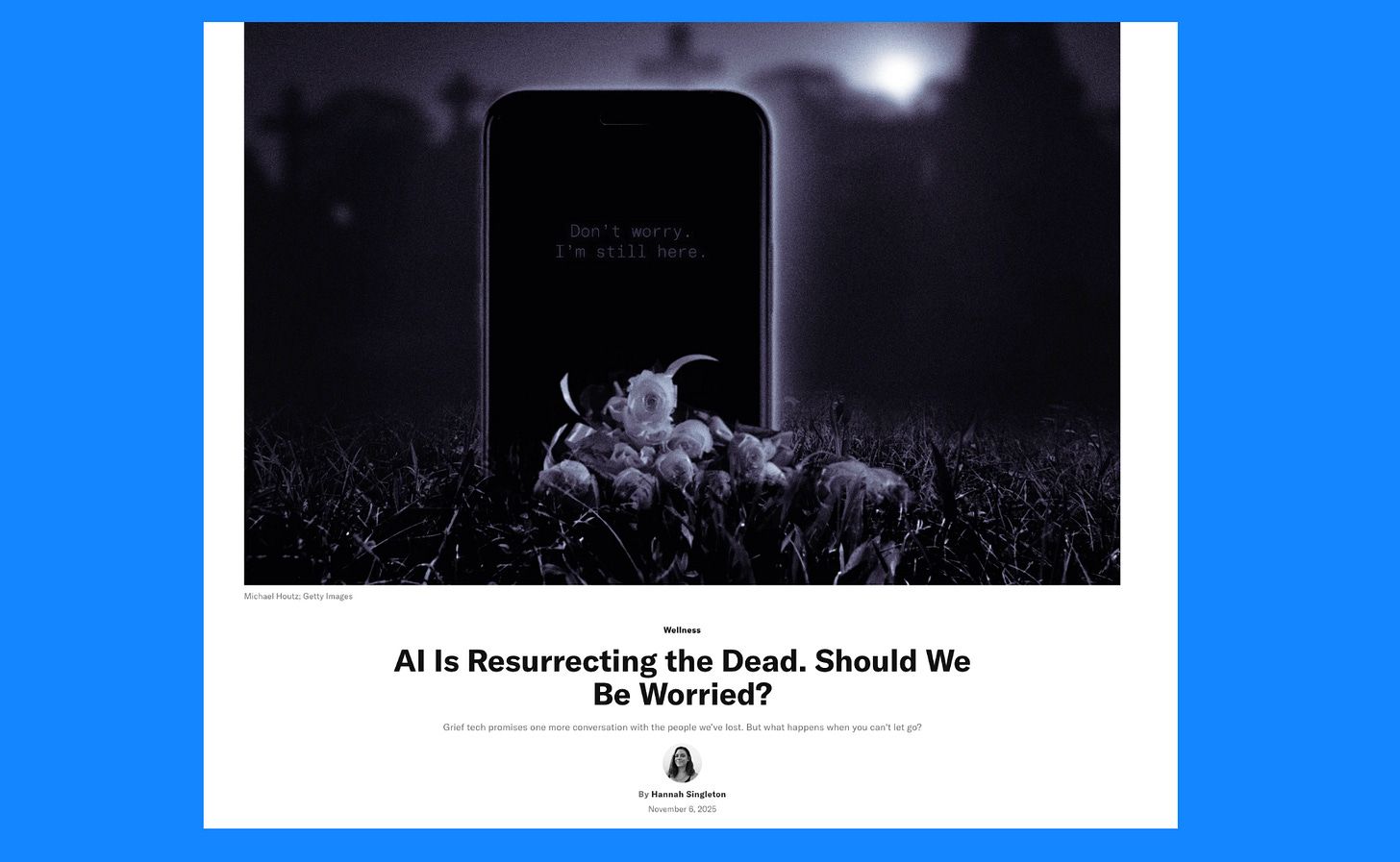
AI resurrects our grandmothers to sell us comfort while strangers reconstruct private women like Carolyn to sell us taste, all of it depending on the same erasure: the dead can’t say no and the content economy has no reason to ask. The silence someone chose in life gets filled in after death not as tribute but as material, the internet offering no mechanism to stop it because resting doesn’t scale and doesn’t make money. I know we’ve always done this, but at what point is too much? The dead need to rest.
Because Carolyn never gave interviews, never posted, and never changed, she became a blank canvas the fashion industry projects onto endlessly, with designers like Carolina Herrera and Sandy Liang citing her, and Sporty & Rich recreating her paparazzi shots. This brings us back to a term mentioned earlier: “ghost influencer.” Vanessa Friedman’s 2023 NYT piece called Carolyn Bessette-Kennedy a “ghost influencer,” arguing that nearly 25 years after her death, her extreme privacy and finite archive of paparazzi photos made her the most referenced fashion muse of the season. The platforms have built infrastructure for what happens to your account when you die, yet they’ve built nothing for what happens to your identity when other people won’t let you die.

Caroline Kennedy does not participate in or endorse media projects about her brother’s personal life. Jack Schlossberg called Love Story grotesque. Members of the Kennedy family have said this resurrection of their family's grief for national entertainment isn't something they are really pumped about. I wouldn't be either.

What do you want to happen to your social media after you die? Who will be your “death mod,” the person responsible for managing your digital presence after you die?
Tech News
Young Men
Axe rolled out new 2.9-ounce bottles with a more controlled sprayer and launched “The History of Overdoing It” campaign. After long-standing complaints about teens over-spraying, the company said the new design delivers a lighter application, up to 10% more sprays, while retaining its 72-hour fragrance claim. Its U.S. deodorant spray market share fell from 24% in 2020 to 16.3% in 2025. (Wall Street Journal)
Due to a shortage of male attendees, some dating events in NYC charged women $100 and men $0, yet attendance still ran 3:1. Some people online are saying it’s time for women to head to San Francisco. I hear the odds are good, but the goods are odd. I will be staying in New York. (New York Times)
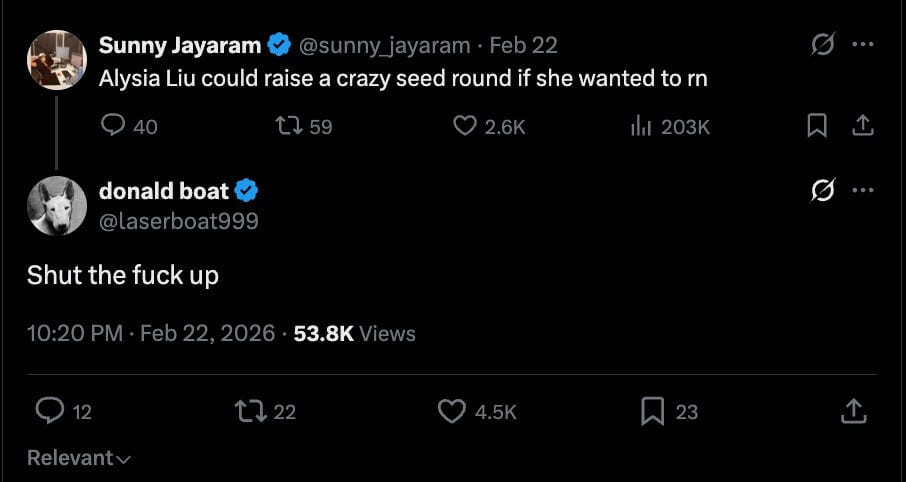
Maybe what it takes to be successful now is just thinking fast and shitposting. Sam Kriss takes a look at the young men shaping Silicon Valley and the online spaces around it. Through figures like Cluely founder Chungin “Roy” Lee, teenage entrepreneur Eric Zhu, and viral internet personality Donald Boat, he explores how success in tech is increasingly tied to initiative and attention rather than expertise or technical skill. (Harper’s)

Money Moves
Santa Fe police requested city council approval for a $350K, one-year ShotSpotter pilot program to detect and locate gunfire so officers can respond more quickly and approach situations safely. The department said the acoustic sensors would provide near-real-time shot locations and target two higher-crime neighborhoods if approved. (KRQE News)

Data center developers are approaching farmers with multimillion-dollar offers for land needed to support new AI infrastructure. (The Guardian)
Companies are pouring billions into AI, but Goldman Sachs economists say it barely contributed to US economic growth last year because much of the hardware is imported and doesn’t count toward GDP. (Washington Post)
OpenAI
OpenAI announced partnerships with BCG, McKinsey, Accenture, and Capgemini to sell and implement its new Frontier AI agent platform. The consulting firms will redesign workflows, integrate AI agents with existing software systems, assist with change management, and provide industry-specific expertise. (Fortune)
Sam Altman said discussions about AI’s energy usage are “unfair,” arguing that it takes “20 years of life and all of the food you eat during that time” to train a human. (Business Insider)
OpenAI said users aged 18–24 account for nearly 50% of ChatGPT messages in India, while users under 30 account for 80%. Indian users send 35% of messages for work purposes compared with 30% globally. (TechCrunch)
Great Scroll Stopper from donald boat
Braun & Brains is a reader-supported publication. To receive new posts and support my work, consider becoming a free or paid subscriber.
Reply