- Braun & Brains
- Posts
- Not OpenAI: Sam Altman’s Other Startup Is Scanning Eyes at Gap, Tinder, and Visa
Not OpenAI: Sam Altman’s Other Startup Is Scanning Eyes at Gap, Tinder, and Visa
PLUS: Pentagon drops Anthropic for OpenAI, 17-year-olds sell $50M ARR calorie app to MyFitnessPal, and kids’ AI storytelling app Giant raises $8M.

Rachel Braun
March 03, 2026
Companies like Gap, Tinder, and Visa are partnering with Sam Altman’s company and no, it’s not OpenAI.
Tools for Humanity, co-founded by Sam Altman and Alex Blania in 2019, created World ID, a digital system designed to prove someone is human online as bots and AI systems increase.
Yes. That is the real name of the company. You read that right.

The system uses a device called the Orb that scans a person’s face and iris and the scan is converted into a cryptographic code stored on the user’s device.
Worldcoin is the project’s cryptocurrency token and part of the broader World network. In many markets, users receive it after completing an Orb scan, creating an incentive layer tied directly to identity verification. (Dystopian to think about a world where we get paid for proving our humanity, but moving on!)
Gap installed an Orb in a San Francisco store so people can sign up in person.
Visa is developing a payment card tied to the system that would allow users to spend digital assets, including Worldcoin.
Tinder is testing World ID in Japan to verify users’ age and confirm they are human, as required by law.
In Japan, MEDIROM Healthcare has installed Orbs at 150+ locations and plans to expand to 3,000 nationwide, projecting up to $39M in pre-tax income over two years. More than 20,000 authentications have already been completed.

The biometric collection device called “Orb” inside Gap. Photo: Gazetteer SF
The company says about 18M people have created a World ID, including 1.1M in North America, according to recent reporting in the Wall Street Journal.
The project has faced tons of regulatory scrutiny and backlash because it relies on biometric data and cryptocurrency. It is not available in New York due to licensing issues (phew). Privacy advocates warn biometric IDs could be theft targets and, unlike passwords, cannot be changed. The company disputes that risk and says the Orb deletes data immediately after processing.
It also seems like an incredibly intense and stressful place to work. Back in November 2025, Business Insider reported that earlier that year, Tools for Humanity CEO Alex Blania told employees the mission should be the only priority and that people seeking balance should not be there. Internal values included working weekends and rejecting “slowness and comfort.”
This expansion into the consumer world, like retail, payments, and dating platforms, signals a shift from crypto-native adoption to broader commercial integration. Now, whether that leads to widespread use will depend on user trust, regulatory approval, and partner adoption.
That trust part is going to be interesting.

Tech News
What happened with Anthropic, OpenAI, and the Department of War
→ Anthropic lost a Pentagon contract worth up to $200 million after it refused to allow its AI models to be used for all lawful military purposes, including surveillance and autonomous weapons. (Anthropic)
→ Defense Secretary Pete Hegseth warned the company that it would lose the deal and be labeled a national security risk if it did not comply. (X, Secretary of War Pete Hegseth)
→ Anthropic CEO Dario Amodei rejected the terms, and President Trump ordered federal agencies to phase out the company’s technology. (CBS Interview)
→ Sam Altman had initially supported Anthropic’s position on AI safety. (Axios)
→ After the contract was terminated, OpenAI announced that it had reached its own agreement with the Department of War. Altman said the deal includes safety limits, even as OpenAI’s models will be deployed on classified military systems. (X, Sam Altman)
→ This triggered a lot of backlash, with some people telling others to cancel ChatGPT and switch to Claude.

→ Over the weekend, Claude daily signups reportedly quadrupled, and free active users increased by more than 60 percent this year. (CNBC)
→ Claude’s US downloads also rose between 51% and 88% day/day, depending on the data provider, and the app climbed to #1 on the US App Store. Meanwhile, ChatGPT’s US mobile app saw uninstalls hit 295% day/day on Saturday, while downloads fell 13%, according to Sensor Tower. One star reviews for ChatGPT also spiked. (TechCrunch)
→ A few hours ago, Sam Altman posted that OpenAI is now revising its Department of War contract to explicitly ban domestic surveillance of US persons, including via commercially acquired data. Any use by intelligence agencies like the NSA would require a separate agreement. He acknowledged the initial rollout was rushed, said OpenAI would refuse unconstitutional orders, and framed the changes as a safeguard for civil liberties under democratic oversight. (X)

~ Related: In a series of simulated war games, researchers tested leading AI models from OpenAI, Anthropic, and Google to see how they would handle geopolitical crises. When given a range of options, from diplomacy to full-scale nuclear war, the AI models chose to use nuclear weapons in 95% of the simulations. (New Scientist)
Scroll Stopping
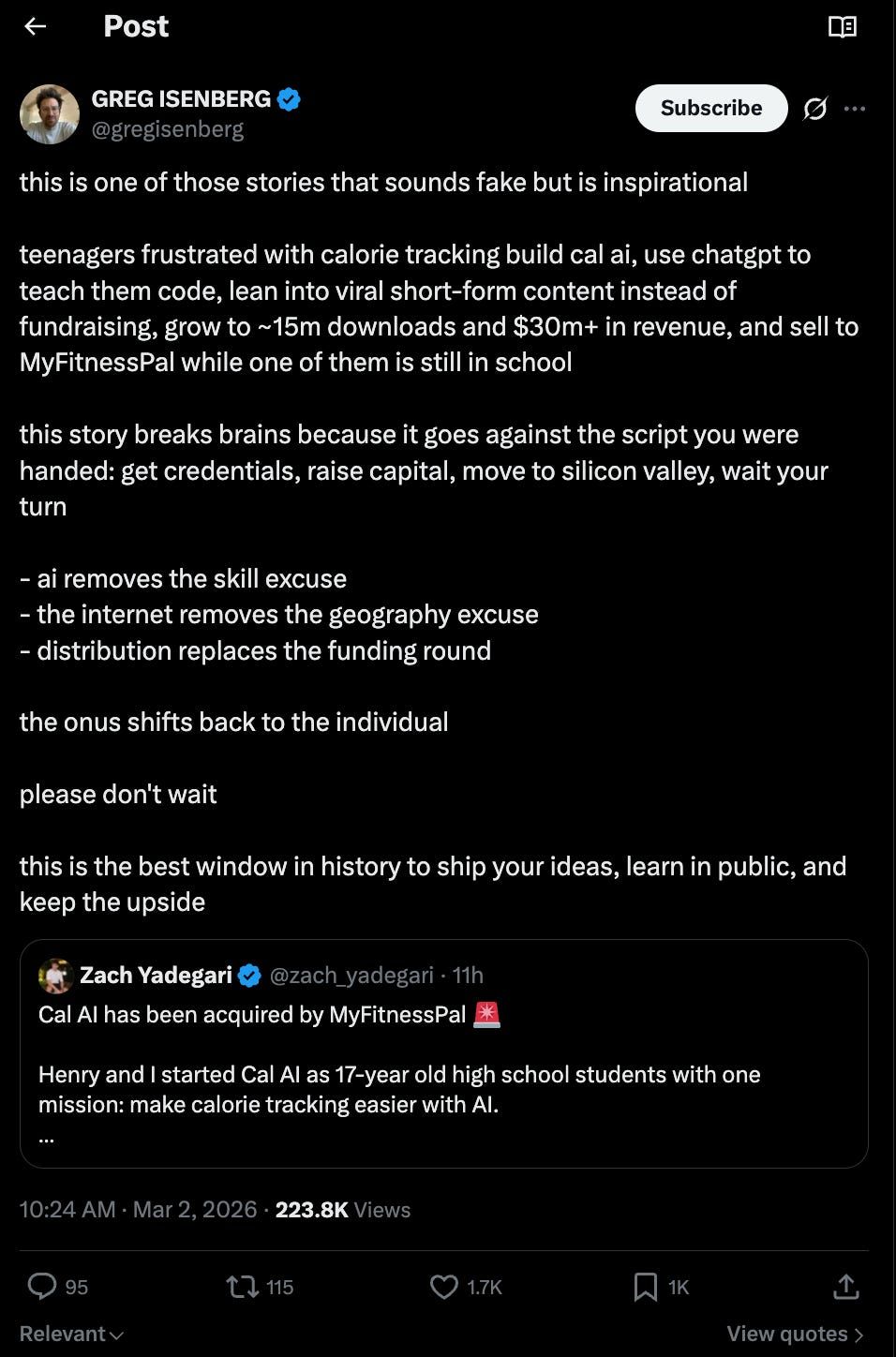
Two 17-year-old high school students built Cal AI, an AI calorie-tracking app designed to improve on MyFitnessPal. One could say this is the age that calories are thought about most. Without raising venture funding, they scaled it to millions of users and roughly $50M in annual revenue in just 18 months. Now, MyFitnessPal has acquired them. (X)
Burger King launched an OpenAI-powered chatbot called “Patty” that lives in employee headsets and evaluates customer interactions for friendliness. The company trained Patty using franchisee and guest feedback to recognize phrases such as “welcome to Burger King,” “please,” and “thank you,” and integrated the assistant into a BK Assistant platform that provides meal-prep guidance, inventory alerts and cloud POS updates. I would feel insane if I worked there. (The Verge)
Big Names
Two founding members of Thinking Machines Lab, led by Mira Murati, have left to join Meta. Christian Gibson, an early ChatGPT engineer, and AI engineer Noah Shpak are the latest in a string of departures as the $12 billion startup faces aggressive poaching. The exits come as Thinking Machines Lab reportedly seeks a $2 billion seed round. (Business Insider)
Toby Pohlen, a co-founder of Elon Musk’s AI startup xAI, is leaving the company following its acquisition by SpaceX in a February 2026 deal that valued the combined entity at $1.25 trillion. Pohlen, who recently led xAI’s “Macrohard” AI software division, is the seventh of the company’s 12 co-founders to depart in the past three years, with Jimmy Ba and Tony Wu also exiting earlier this month. (Bloomberg)
Money Moves
Sophia Space raised $10 million to build space computers that can run powerful chips without traditional cooling systems. Instead of bulky satellites with large radiators, the company is developing thin, solar-powered modules called TILES that use passive cooling. It plans to test the system in orbit by 2027 or 2028, with a long-term goal of building large space-based data centers. (TechCrunch)
Giant, an interactive storytelling platform for kids, raised $8 million in seed funding to expand its AI-powered product that turns children into the creators and stars of their own stories. Since launching in May 2025, the company has surpassed 1 million minutes of conversation and generated more than 200,000 personalized episodes. Giant positions itself as a safe, ad-free alternative to passive screen time, focused on imagination, creativity, and child-safe design. (Business Wire)
Reply